Sunday, November 29, 2009

Religion and marriage

[Is 'Hindu Atheism' Valid? A Rationalist Critique Of The 'Hindu ... By Ajita Kamal - For example Aurobindo Ghose emphasized that 'all great awakenings in India, all her periods of mightiest and most varied vigour have drawn their vitality from the fountainhead of some deep religious awakening' (Purani 1964: 81). ... Nirmukta Posted on 28 November 2009
Many Indians intellectuals who don’t believe in supernatural gods or powers fail to separate their non-belief from the ‘Hindu’ identity... Hinduism is a meaningless religious label... Religions have always benefited when the facts are ambiguous. One such religion-driven ambiguity is in the definition of the notion of religion itself. This is the first place to start any such discussion on religion. From a scientific point of view, we can define religion as a sub-group within a culture, possessing certain specific traits. The most fundamental of these traits is the strong group identity that religion strives to instill in its followers.]

[“I regret to say,” write Raja Ram Mohan Roy in 1828, “that the present system of religion adhered to by the Hindus are not well calculated to promote thier political interests. The distinction of caste introducing innumerable divisions and sub divisions among them have entirely deprives them of patriotic feeling, and the multitude of religious rites and ceremonies and the laws of purification has totally disqualified from undertaking any difficult enterprise. It is, I think necessary that some change should take place in their religion at least for the sake of thier political advantage and social comfort.” How freedom movement is related to social and religious reform movement in pre independence India: An Analysis Posted by medieval
Medieval Weapons Nov28]

[Frame norms for inter-faith unions, girl requests SC Times of India - ‎Nov 27, 2009‎
"Directions are required and guidelines be given by the apex court in a Muslim or inter-religion marriage, so that peace and tranquility prevails for ...
SC notice to JK Govt on honour killing of youth by cops Expressindia.com]

Welcome to Savitri Era Religion. [TNM]

Saturday, November 28, 2009

Spirituality divides

[The fact that the subjective age - which aside from Sri Aurobindo was conceived in many modernist writings of the late 19th and early 20th century - has not smoothly transitioned into a spiritual age, but rather an age of late Capitalism, post-modernism, post-humanism or whatever one wishes to call it, does not shed light on either the success of failure of the project of Integral Yoga, because as you say the current age in itself is equally an expression the multiple worlds at play within the infinite's self-conception. But this matter brings up an issue concerning a wider dialog of the yoga and culture, in that due to the turn that evolution of consciousness has made the uncritical assertion of a progressive spiritual evolution is problematic when applied to any collectivity.
Therefore, what is more fascinating -at least for myself- is the tension between these Utopian tendencies characteristic of the Modernist period (late 19th early 20th century) and the often dystopian, machinic, computational view of reality that defines much of the writing and art of late Modernism and the post-human period we find ourselves confronted with today. Although I dont see any widespread interest in such a dialog I am a bit heartened by the latest works of those trying to re-construct unifying narratives of hope out of the ashes of the ideological ruins of Modernity. (I especially liked how the Kroker's concluded Virilio in Obama's America) Re: Science, Culture and Integral Yoga :: Xul Solar by Rich on Sun 02 Nov 2008 Permanent Link]

[It seems to me that generally - identity is morphing (or if one would rather call it evolving) in some instances it is becoming more protean, pliable, elastic, - but in other instances it may becoming even more entrenched in its identification with the body and all that signifies, (ethnicity, nationality class,) One could ask I suppose if the forms of spirituality that are culturally co-evolving as part of this whole process of change sufficient or in fact ask: just how relevant words like spirituality are -when assigning them a value as a placeholder for a certain type of experience - when the very articulation of the word inevitably divides the world into that which is spiritual and that which is not? aka. Is there a way to overcome the binary process of languaging a world? Re: LACMA 111909 - Debashish Banerji Tony Clifton]

Richard Carlson (Tony Clifton), very sensitively, disputes the homogenizing propensity of notions like evolution and spirituality. As there can be no perfect answer to his objections within the human condition a la Gödel's theorem, Pascal's Wager seems to be the best bargain in the circumstances. [TNM]

Merits of unity and a common faith

Tusar N Mohapatra has left a new comment on your post "Barin Ghose, Dilip Kumar Roy, and Anna Bogenholm Sloane":

The picture Reddy paints gives an impression that Integral Yoga is Ashram bound and hence leaving it tantamounts to failure. Mercifully, his thesis is not wholly true.

Devine, on the other hand, links dogma with tyranny and that presupposition eliminates the merits of unity and a common faith. [TNM] Posted by Tusar N Mohapatra to Aurora Mirabilis at 8:29 AM, November 28, 2009

Friday, November 27, 2009

Ortega y Gasset does more with authenticity than Heidegger does

[speaking of likes and dislikes
from Object-Oriented Philosophy by doctorzamalek
Speaking of likes and dislikes, I think that the best model of philosophical engagement would not be a neutrally distant critique, whether of the sneering or politely aloof variety.
What I really want to hear from a commentator is this: which aspects of the text commented upon do they most passionately enjoy and detest? This is one reason I’ve always loved Badiou’s book on Deleuze (in fact, it is my favorite Badiou text, and always has been). Badiou comes and lays his cards right on the table, telling us what he likes and dislikes about Deleuze, and how he thinks it differs from his own position. Nice job.] [
some disingenuous claims
from Object-Oriented Philosophy by doctorzamalek
I’ve blogged before about ways in which people use adjectives dishonestly.]

[Education here is based on rote memorisation, with virtually no emphasis on creative thinking. Few schools here even teach the theory of evolution...
In large part because of the emphasis on memorisation over critical thinking, many here say, the quality of the education is poor. While countries in the region often spend as much or more than the world average per pupil, the results are frequently far below average.
Egypt, for example, once considered the intellectual capital of the Arab world, was recently ranked 124th of 133 countries in the quality of its primary education by the World Economic Forum, based in Switzerland. Other global assessments have provided equally dismal results. Harnessing Darwin to push an ancient intellectual centre to evolve Michael Slackman © 2009 The New York Times News Service]

[The secular liberalism of the nation-state has demanded conformity and obedience from Europe’s citizens. Upholding an abstract idea of the individual citizen divested of his religious and ethnic identity, this liberalism has not had an easy relationship with Europe’s ethnic and religious minorities, to put it mildly; the current obsession with Muslims, for instance, betrays a deep unease with expressions of cultural distinctiveness (previously exemplified in Western Europe by Jews). Pankaj Mishra, Beyond boundaries UAE / Friday, November 27, 2009 Abu Dhabi 6:56 AM]

[International Congress in Auroville “Spirituality beyond Religions”, 5-8 January 2010 Mon, 06/15/2009 - 11:42am — International Congress in Auroville, 5-8 January 2010 “Spirituality beyond Religions” A New Path to a Universal Cultural Dialogue]

Graham Harman blogging from Cairo holds a great promise for the East-West reappraisal. [TNM]

Wednesday, November 25, 2009

Mediteation

A pleasant afternoon and I reach Delhi Ashram. A magnificent and majestic Meditation hall welcomes me. My heart fills with joy. But the memory of the old building which used to be my weekly haunt in the nineties spurs mixed feelings.

Sri Aurobindo’s symbol within a circle can stand alone as a logo, but juxtaposed to The Mother’s symbol it appeared to be an oddity and avoidable distortion. Inside, my jaw dropped on confronting the photographs of the Masters fixed so wide apart.

Ganesh Vandana on Siddhi Day seemed disconcerting, but, however, was enjoyable in the classical style. Then, she sang another Gajanan Stuti. Irritated, I headed for tea.

On asking for a coupon, the gentleman at the reception informed me that tea is free on Darshan Day. A glass in hand I went to the counter in the Dining hall but the lady refused as only lunch and dinner are free but not tea. Offended, I put the glass back and went to the reception again to buy a coupon. When I had tea and snacks finally, the taste obviously was bitter.

The March Past, the evocative Vande Mataram, and the lighting of lamps ceremony brought cheers. Not even 24 persons were present to witness when the function began. And this city is home to 12 million people, alas.

Fearing that the tea episode will fill my meditation, I left, foregoing the free dinner, perforce. [TNM]

Sunday, November 22, 2009

Weighing in on WWI in 1914

[I wonder what the “late period” of Nietzsche would have been like. And that’s another interesting thought experiment… Nietzsche as a respected commentator in 1914, weighing in on WWI, a celebrated figure and the winner of the Nobel Prize in Literature. He barely missed living long enough to see the end of his obscurity. another thought while reading Schopenhauer
from Object-Oriented Philosophy by doctorzamalek]

Sri Aurobindo embarks upon The Life Divine in 1914. [TNM]

Social Capital & Soft Power

[How to be a cultural superpower Home » Sunday TOI
Hard power can drive people away but soft power almost always brings them closer. This is why nations with big ambitions have always used cultural exports to enhance their clout. Shobhan Saxena November 22, 2009
] ['India is also rock & pop' Shobhan Saxena
Dr Karan Singh has worn many hats - maharaja of Kashmir, governor, ambassador, minister, scholar, writer. Now, as head of the ICCR, the 79-year-old Congress leader is leading India's softpower offensive. He talks culture, politics and pop exports to Shobhan Saxena.] [
Rs 150cr to hardsell India? Pavan K Varma
Only recently is India waking up to the real potential of 'soft power', that curiously Freudian expression coined by Joseph Nye.]

[I also think Schopenhauer’s basic outline of the different periods of life is correct, though I wouldn’t put such a hopelessly pessimistic spin on them as he does. In particular, the idea that each person’s character shines best in one period of life is very strong, and it is perhaps also the case that each nation’s virtues are best suited to one particular historical era. (Like many people, I’m expecting Asian dominance of the world before too long.) more on Schopenhauer
from Object-Oriented Philosophy by doctorzamalek]

International relations are fast altering and the East-West equilibrium is likely to display drastic makeover within a not so distant future. The momentum is said to be propelled by economics at the moment, but a deeper look would point at a range of Social Capital.

An apparent instance is the steadfastness of Japanese work ethic. Korean dexterity and Chinese resilience too have contributed to their respective prosperity. Overall, a resurgent spirit is at work all over Asia. But the challenge is to build on strong foundations of Soft Power.

The Mother and Sri Aurobindo, through their joint venture, have heralded such a blueprint backed by some finest arguments set forth in superb prose (and poetry). No set of proposals – either past or present – can equal the brilliance of their recommendations. The imperative, therefore, is to follow or perish. [TNM]

Saturday, November 21, 2009

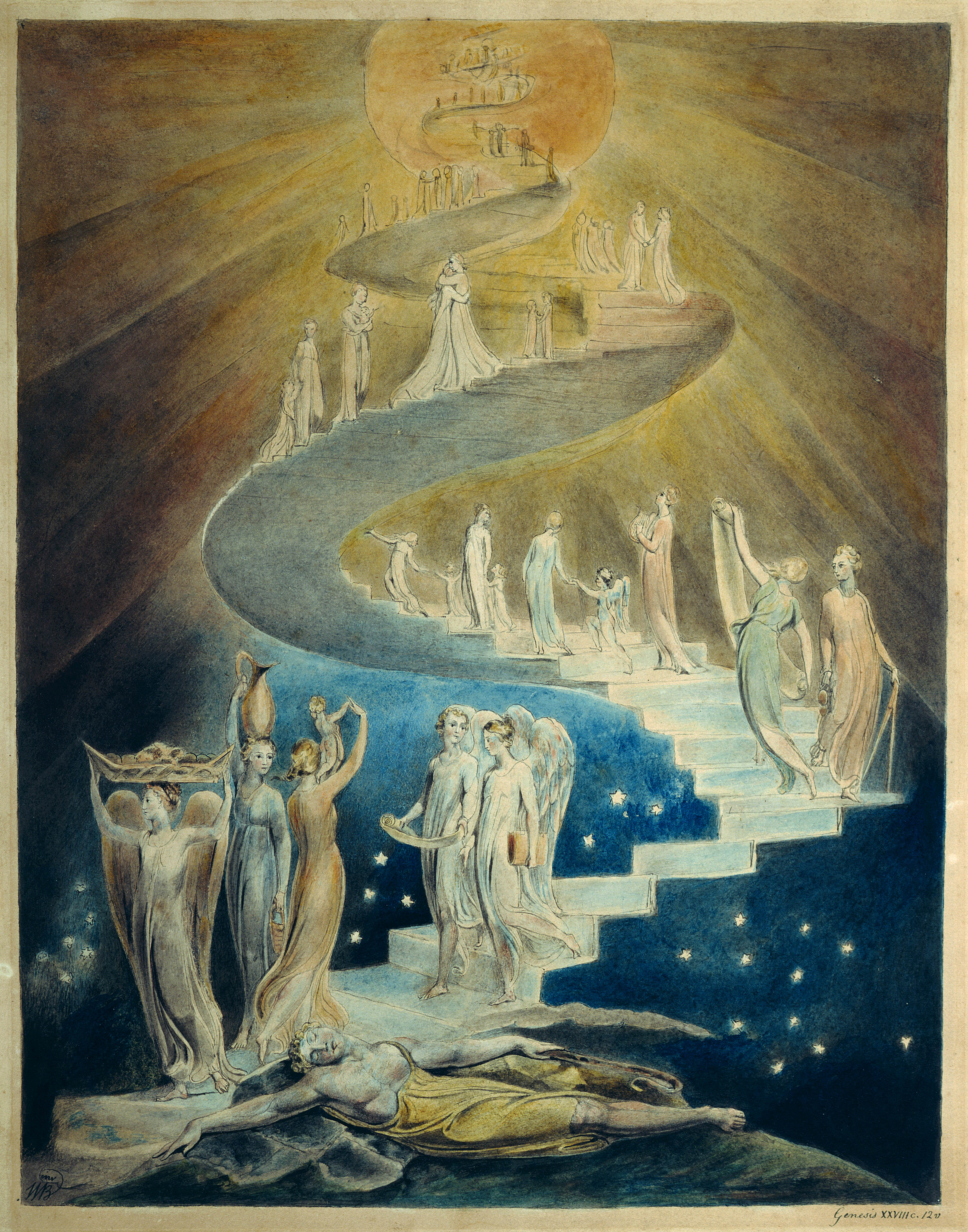
The Ascent to Truth grew out of a painting made by The Mother

[The Mother (of Sri Aurobindo Ashram)‎ - Page 108 Prema Nandakumar - Biography & Autobiography - 1977 - 136 pages
As for the playlet, The Ascent to Truth, it grew out of a painting made by the Mother of the Hall of Aspiration. A group of people (the philanthropist, ...]

cf. Jacob's Ladder by William Blake (1757–1827). [TNM]

Sunday, November 15, 2009

An indispensable work

[The lives of Sri Aurobindo - Google Books Result
by Peter Heehs - 2008 - Religion - 496 pages Biographers usually focus solely on Aurobindo's life as a politician or sage, but he was also a scholar, a revolutionary, a poet, a philosopher, a social and ...]

Thanks to Google Books, I read a few pages of the book for the first time this morning. The impression I gathered was it is an indispensable work.

The Many Lives of R.C. Dutt by Meenakshi Mukherjee is also an interesting recent publication as “a prism which refracts the relationships between the West and India, colonialism and nationalism, elite and subaltern Indians, literature and history and much else.” [TNM]

Friday, November 06, 2009

Political nullity

The following offers an apposite backdrop to The Bourgeois and the Samurai by Sri Aurobindo that promptly pricks conscience:
  • "Hegel also offers the first polemically political definition of the bourgeois. The bourgeois is an individual who does not want to leave the apolitical riskless private sphere. He rests in the possession of his private property, and under the justification of his possessive individualism he acts as an individual against the totality. He is a man who finds his compensation for his political nullity in the fruits of freedom and enrichment and above all in the total security of its use. Consequently he wants to be spared bravery and exempted from the danger of a violent death." [The concept of the political - Google Books Result by Carl Schmitt, George Schwab - 2007 - Philosophy - 126 pages]

[TNM]

Monday, October 26, 2009

There’s no reason to privilege mind

Blogging by Larval Subjects is a high point of Cyberspace:

  • "Graham, of course, has had a decisive impact on my thought and has led me to read figures such as Zubiri, Bhaskar, and Latour. Mel introduced me to Latour, Kittler, Ong, Bogost, and a whole host of other thinkers. Shaviro got me back into Whitehead. And so on." October 22, 2009 Speculative Realism, Armies of Objects, and the Social Sciences
  • "However, if the last 300 years of philosophy have shown us anything, it has shown us that we do not have any direct or immanent or immediate access to our own minds. As Lacan liked to say, following Freud, the subject is split. This is true even in Kant, as can be seen in both the paralogisms and the the deduction where Kant distinguishes between the subject as phenomena to itself, the transcendental unity of apperception, and the subject in-itself. Similarly, phenomenology increasingly discovered just how elusive givenness is in intuition, or how there is no immediacy in consciousness.
    Yet if we follow through the implications of these points, then it would seem that there’s no reason to privilege mind (or some variant thereof) in our transcendental arguments." October 22, 2009
    Transcendental Realism?
  • "To be quite honest, I’m rather surprised that certain philosophers of religion and theologians haven’t exploited this point when characterizing me as the wicked, secular-humanist, materialist atheist.
    For if the ontic principle is rigorously followed through, then there’s nothing that allows me to prohibit God, and other things besides, from the order of being. A theology or philosophy of religion premised on the ontic principle might lead to some surprising results contrary to traditional theistic conceptions of God where God overdetermines everything else, but the very coordinates of my thought prevent me from excluding the divine as productive of difference... I also suspect that this is the reason that some theologians and philosophers of religion have been rather enthusiastic about object-oriented ontology and the ontic principle.
    In the end, I take it that as leaky as my ship is, this capacity to surprise is the mark of a good philosophy or ontology. Since I first formulated the ontic principle in January or February, I’ve been on a witches broom of thought, no longer knowing where I’m being led or am going. In other words, my basic ontological commitments might not only be surprising to others, but are surprising to me as I carry out their implications. I do not take this as a negative thing, but as precisely what a philosophy should do."
    Realism is not a Synonym for Materialism

Let's hope that the logic of Larval Subjects finally rams into Sri Aurobindo's The Life Divine. [TNM]

Saturday, October 24, 2009

No one yet knows for certain what exactly Sri Aurobindo says

The judgmental spirit has overtaken us; a magisterial impulse. Everyone is on a spree to pass verdicts on anything under the sun. It seems that years of fear and suppression has found a vent as more and more of us are mustering courage to contribute to a discursive environment.

The difficulties are many. For instance, the complete works of Sri Aurobindo are yet to come out. So, no one can claim that he has gone through the Master’s entire oeuvre. In other words, no one yet knows for certain what exactly Sri Aurobindo says.

The publishing programme thus far has adopted an ivory tower approach. Evidently, complains and criticisms are surfacing. Involving informed users would go a long way in making the books blemish free in future.

Writings apart, the dynamics of interaction among the followers needs to be adequately debated upon and suitable structural apparatus put in place. Espousing a democratic and tolerant milieu for relating to The Mother & Sri Aurobindo at diverse levels is also a cardinal requisite.

Sri Aurobindian ontology and its socio-political implications is an unfolding story for which we need to be patient and polite without betting on any kind of finality. What all we have been told so far are just hints and allusions, and hence it would be foolish to make them prestige issues.

Public pronouncements by the followers, therefore, should be made after careful consideration of the matter. While commenting on socio-economic issues, responsibility should be assumed by disclosing full name, address and profession. Otherwise many a time, it looks like a childish hit-and-run tactic. [TNM-241009-Sat]

Tuesday, October 20, 2009

Dialogical in Sri Aurobindo and Habermas

Affirming "We are all in his debt," on JĂĽrgen Habermas’s eightieth birthday (The philosopher-citizen 6:39 PM), Charles Taylor underscores several points:

  • "Whereas for Kant the principal criterion of a rational and therefore defensible deliberation was that it was sought universalizable maxims, for Habermas the very notion of deliberation is transformed."
  • "In other words, for Habermas, ethical deliberation is primarily social, dialogical; it is worked out between agents."
  • "Drawing on the work of Weber, Habermas sees modernity as having brought about a transformation in our understanding of reason."
  • "For Plato and much of the Western tradition, reason is a single faculty or power which can strive to define not only the True, but also the Good and the Beautiful. That is, the same reason can establish the shape of all the important dimensions of human life: establishing what really is, deciding what we ought to do, and determining what is truly beautiful. We might speak of the scientific, the moral and the aesthetic dimensions of human life. What Habermas proposes in the place of this is not, as we have seen, a restriction of reason to the scientific domain, and a relegation of morals and aesthetics to the arbitration of emotion or subjective taste. Rather it is a diversification of the very procedures of reason."

Sri Aurobindo too expounded on a similar need for diversification and self-enlargement in the last issue of Arya (January 1921) as below:

  • "The German thinker’s idea that there is a categorical imperative laid upon man to seek after the right and good, an insistent law of right conduct, but no categorical imperative of the Oversoul compelling him to seek after the beautiful or the true, after a law of right beauty and harmony and right knowledge, is a singular misprision. It is a false deduction born of too much preoccupation with the transitional movement of man's mind and, there too, only with one side of its complex phenomena. The Indian thinkers had a wiser sight who, while conceding right ethical being and conduct as a first need, still considered knowledge to be the greater ultimate demand, the indispensable condition, and much nearer to a full seeing came that larger experience of theirs that either through an urge towards absolute knowledge or a pure impersonality of the will or an ecstasy of divine love and absolute delight, — and even through an absorbing concentration of the psychical and the vital and physical being, — the soul turns towards the Supreme and that on each part of our self and nature and consciousness there can come a call and irresistible attraction of the Divine. Indeed, an uplift of all these, an imperative of the Divine upon all the ways of our being, is the impetus of self-enlargement to a complete, an integralising possession of God, freedom and immortality, and that therefore is the highest law of our nature." (Page-214, The Higher Lines Of Truth Part II, The Problem of Rebirth)

It is interesting to note that the Arya began with an invocation to the Kantian categories of God, freedom and immortality in the opening paragraph of The Life Divine, and the scrutiny was on even in the last issue and remained inconclusive. [TNM-201009]

Friday, October 16, 2009

The Mother & Sri Aurobindo are not accorded the central role

[Sri Aurobindo does concur with the monotheistic traditions of Judaism, Christianity, and Islam that the Divine is ultimately single and unitary, and that It represents itself in humans as immortal souls. However, he prefers the Hindu metaphysic of polymorphous monotheism, according to which the one God can differentiate itself into in a plethora of attenuated forms, vehicles, creations, forces, and beings. So, in summary, Sri Aurobindo believes that God made all, all is God, God is in all and also beyond all, the All is all growing, God is growing in all, and we are all growing into God. Towards a spiritual psychology Bridging psychodynamic psychotherapy with integral yoga
Michael Miovic
Consciousness and Its Transformation Cornelissen, Matthijs (Ed.) (2001)]

[Sri Aurobindo calls the soul the “psychic being”, coining his term from the Greek root psyche, and defines it as the true and eternal entity within us that is part of the Divine and persists after the body dies. Sri Aurobindo concurs with the monotheistic traditions of Judaism, Christianity, and Islam that God (the Divine) is ultimately the sole reality and supreme being. However, he prefers the Hindu metaphysic of polymorphous monotheism, which generously allows the one God to differentiate into the multitudinous forms, beings, and forces of the spiritual and material worlds. This kind of God is simultaneously transcendent, immanent in all creation, and personally present for the individual according to the needs of his/her character and culture. Sri Aurobindo does accept the Hindu notion of reincarnation, but places a new emphasis on the evolutionary aim of the Divine plan. That is, he believes that the purpose of reincarnation is not to prepare the soul to transcend the cycle of karma (as in the classical definition of nirvana), but to increase the soul’s capacity to perfect life in the world. Indeed, he argues that this evolution of consciousness is the spiritual force driving the evolution of biological forms that are increasingly able to express it (e.g., the evolution of the mammalian brain culminating in the human brain). TOWARDS A SPIRITUAL PSYCHOLOGY: Bridging Psychotherapy with the Yoga Psychology of Sri Aurobindo
Michael Miovic, M.D.
A Journal of Integral studies - February 2005]

In such an ontological frame, The Mother & Sri Aurobindo are not accorded the central role. [TNM]

Sunday, October 11, 2009

Spend some time in the Aurobindian archive

[For The Turnstiles By DGA - My position is that Aurobindo is a writer of significance, a major cultural figure, who is sadly under-read by those who are not his disciples.... If one is concerned that Aurobindo is not represented properly or fairly or in a balanced way in academic discourse (I am such a one), spend some time in the Aurobindian archive, develop a worthwhile question, do your research, and publish your findings. For The Turnstiles]

Thank you, Anderson. [TNM]

Religion, language and region

[Guard against politics of religion, language and region: Sonia
Times of India - Vishwas Kothari - ‎KOLHAPUR: In a veiled reference to rival Shiv Sena-BJP alliance, Congress president Sonia Gandhi said here that people need to ask those who play politics of votes in the name of religion, language and region, as to what work they did for Maharashtra ...]

What is politics then? one wonders. [TNM]

Friday, October 09, 2009

How to choose a leader

[AMBANI DISPUTE: The finance minister advised the feuding Ambani brothers to reflect on the impact their quarrel is having on the corporate sector, days before they face off in the Supreme Court in a dispute over the sharing of gas from the KG Basin. An old friend of the Ambani family, Mr Mukherjee reminded Mukesh and Anil that their dispute “is not merely an individual matter” and hoped that "good sense would prevail on the two brothers.” Economy to pick up pace from 2nd half: Pranab Mukherjee
Economic Times - Andy Mukherjee]

['Loyalist' Venkaiah thickens Advani quit plot
Calcutta Telegraph - New Delhi, Oct. 8: LK Advani “loyalist” M. Venkaiah Naidu has indicated that Advani will quit as leader of the Opposition at a time of his choosing,]

Not only the Ambani brothers, leadership struggle is currently an integral part of every political party. Even our professedly Hindu parties have no clue as to how to choose a leader in consonance with traditional wisdom. [TNM]

Monday, October 05, 2009

How in heavens to do you translate 'daiya!'?

[Google Reader (14): We might run our governments in English and write our balance sheets in Roman, but we sing, cry, laugh and love in Hindi, Urdu, Marathi, Bengali, Bhojpuri, Kashmiri, Tamil or any of the innumerable mother tongues with which our nation is blessed. A paean to India's melody queen
from M.J. Akbar - Author and Veteran Journalist by M J Akbar Appeared in Times of India - October 4, 2009]
Blessed or cursed? [TNM]

Socratic nook

[Google Reader (51): Comments from Larval Subjects . by larvalsubjects
In light of recent events, and after lots of reflection and a good deal of regret, I have decided to follow the advice of a number of you and turn off the comments section on Larval Subjects.]

As one of the most invigorating spaces, this would be shortlived, one wishes. [TNM]

Saturday, October 03, 2009

Buddha disinformation

from Tusar N. Mohapatra tusarnmohapatra@gmail.com to Jagannath Chatterjee
date3 October 2009 10:18
subject Re: [DevComm] Orissa is the birthplace of Lord Buddha.
The popular notion of Buddha, like many relics of the past, is a myth. Emotional bonding with a certain legend is a childlike quality and hence harmless, but to prop it with rational seeming proofs is a political misadventure likely to spread disinformation.
Reading the works of The Mother & Sri Aurobindo can teach us many things. Rectitude in thought is one of them. [TNM]

Thursday, October 01, 2009

Karlekar's own clan is no less responsible

[The Pioneer > Online Edition : >> A nation in amnesia: OPED Thursday, October 1, 2009 Email Print
A nation in amnesia
Hiranmay Karlekar
Why pundits ignore Sri Aurobindo’s vision
Prof Sachidananda Mohanty says in his well-written and painstakingly-researched work, Sri Aurobindo: A Contemporary Reader (Routledge), “I have often wondered why university intellectuals are reluctant to engage with Sri Aurobindo.” ... However carefully nuanced Marx’s critique, his rejection of religion was total; so was that by Marxist intellectuals, whose influence grew in a great measure because of the support of the entire global and Indian Communist movements behind them. On the other hand, the Vedantic tradition no longer had a charismatic leader like Swami Vivekanand and Sri Aurobindo or a stalwart literary and mystical figure like Rabindranath Tagore. Finally, given the growing complexity of modern societies and the increasing importance social, political, administrative and economic activity, subjects related to these commanded precedence in the universities. Growing specialisation in the academic world left one with little time for anything-including one’s own spiritual heritage and its exponents — outside one’s own discipline. This is an absolute shame. Sri Aurobindo’s universal and cosmic vision has much to offer to a troubled world.]
Karlekar's own clan is no less responsible for neglect of Sri Aurobindo. [TNM]

Wednesday, September 30, 2009

Vacuum packed ontology

[Google Reader (10): For Graham all objects are vacuum packed and withdraw from one another. Dark matter and energy are perfect examples of this thesis. We only encounter it, in my formulation, through the differences it produces in other things. Yet here we have the interesting epistemological question of why we should affirm its existence at all. It quite literally is a ghost. Perhaps the physicist readers of this blog can help me out here. Dark matter is certainly very strange stuff. Dark Matter and Energy
from Larval Subjects . by larvalsubjects]

[In a letter appearing in Sunday’s Washington Times, protectionist William Hawkins accuses Adam Smith of being “dreadfully wrong” to insist that the ultimate goal of economic activity is consumption rather than production. Alas, the dreadfully wrong one is Hawkins. He confuses means with ends... Adam Smith correctly understood that the desire to consume is what justifies production, and not vice-versa. Protectionists are Profoundly Confused
from Cafe Hayek by Don Boudreaux]

Enhanced consumption of ontology justifies production of more vacuum packed books and blogs. [TNM]

Monday, September 28, 2009

Hoooles

[Of all Harman’s ideas, the manner in which objects withdraw from one another is particularly interesting in this regard. Does one need to theorise the gap/space between objects - if such there is - in terms of a boundary (e.g. chora/chasm)? But, more significantly, for me at least, how does this relate to Harman’s other intriguing boundary concept: the “firewall”, the demarcation point between objects, as well the term for the internal boundaries between objects and their parts. If I am to write something about Harman’s OOO in the near future, it is the firewall that has me suitably “fired up”, that and the theorisation of the nature of the gaps between objects (again, if such there are). Chasm, Chora and Firewall: On the Boundaries Between Objects from Pagan Metaphysics by Paul Reid-Bowen] [aggregator]

More holes likely to surface once the honeymoon evaporates and hegemony subsides. [TNM]

Friday, September 25, 2009

Politics of caste, gender & religion

[The politics of immigrant identity negotiation is rather starkly framed in the title of a paper by Arvind Rajagopal: “Better Hindu Than Black?” By choosing actively to identify in terms of religion, rather than allowing themselves to be categorized simply in terms of the more limited logic of ascribed American racial identities, Hindus from India and Muslims from West Africa, for example, can improve their chances of achieving recognition as full members of the polity. Multi-religious denominationalism and American identity
from The Immanent Frame by Richard Amesbury. In the emerging dispensation, Taylor predicts, “it will be less and less common for people to be drawn into or kept within a faith by some strong political or group identity, or by the sense that they are sustaining a socially essential ethic.”]
[Gender, Migration, and the Public Sphere, 1850–2005
Edited by Marlou Schrover, Eileen Yeo
The decision to emigrate has historically held differing promises and costs for women and for men. Exploring theories of difference in labor market participation, network formation and the immigrant organising process, on belonging and diaspora, and a theory of ‘vulnerability,’ A Global History of Gender and Migration looks critically at two centuries of the migration experience from the perspectives of women and men separately and together. ISBN: 9780415801720 Published September 15 2009 by Routledge.]
[R. Jagannathan, in DNA, suggests that the reason may be caste. Centuries of caste-based protection has made Indians reluctant to change; afraid to abandon the old even after it has outlived its utility. Therefore, he says, we are afraid of the outcome of democracy.
“Caste is like the shell of the tortoise. When faced with predators, the tortoise withdraws into its shell. Caste was the protective shelter under which the Indic peoples withdrew when confronted with the radical new ideologies of Christianity and Islam. So successful has caste been as protector, that even the others have adopted it. Caste now permeates Indian Islam and Christianity, not to speak of Sikhism, Buddhism and Jainism. Put another way, caste is a force independent of Hinduism.”
Read the full article:
BJP’s succession blues. ‘Caste is what has made Indians fearful of change’
from churumuri by churumuri]

A definitive account of human emotions is hard to establish, and hence we have to make do with whatever appears as rigorous and scholarly. [TNM]